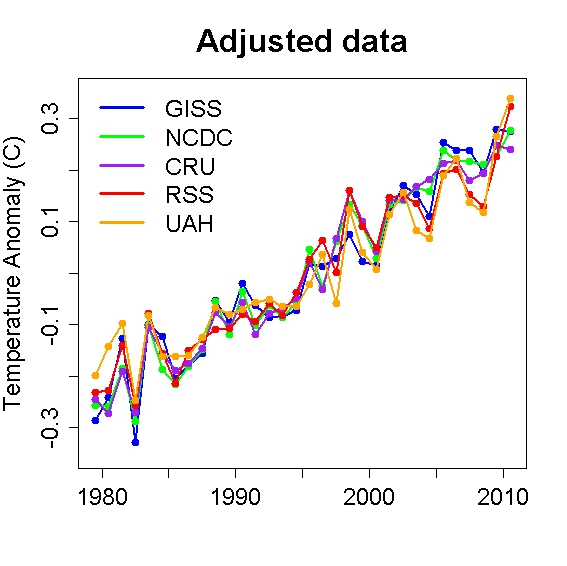
Well, we can disregard Jim Hansen as alarmist whacko, or, more wisely, we can regard him as one of the most experienced and respected climate scientist with 25+ years of experience with top climate change research. In his latest paper together with co-authors he writes:
"Therefore we can say with a high degree of confidence that events such as the extreme summer heat in the Moscow region in 2010 and Texas in 2011 were a consequence of global warming."
And:
"People who deny the global warming cause of these extreme events usually offer instead a meteorological "explanation". For example, it is said that the Moscow heat wave was caused by an atmospheric "blocking" situation, or the Texas heat wave was caused by La Nina ocean temperature patterns. Of course the locations of the extreme anomalies in any given season are determined by the specific weather patterns. However, blocking patterns and La Ninas have always been common, yet the large areas of extreme warming have come into existence only with large global warming. Today's extreme anomalies occur because of simultaneous contributions of specific weather patterns and global warming. For example, places experiencing an extended period of high atmospheric pressure will tend to develop drought conditions that are amplified by the ubiquitous warming effect of elevated greenhouse gas amounts.
Why is this climate shift important? Can't we just say, o.k., we have a new climate, we will adapt to this new temperature probability distribution? Biology and ecosystems on our planet are adapted to the rather stable climate of the Holocene, the past 10,000 years or so. Local climate effects of global warming, arguably, are already noticeable and significant,, but the big problem is that more warming is already in the pipeline without further increase of greenhouse gases and the gases are continuing to increase. The most important effects of the warming probably come via the effect of warming in exacerbating the extremes of the hydrologic cycle: more intense droughts at times and places where it is dry and more extreme precipitation and floods at other times."
Full article here .